Herculaneum from Naples: a 20-minute Circumvesuviana ride, 2026 tickets and hours, two hours among houses, mosaics and the buried ancient shoreline.
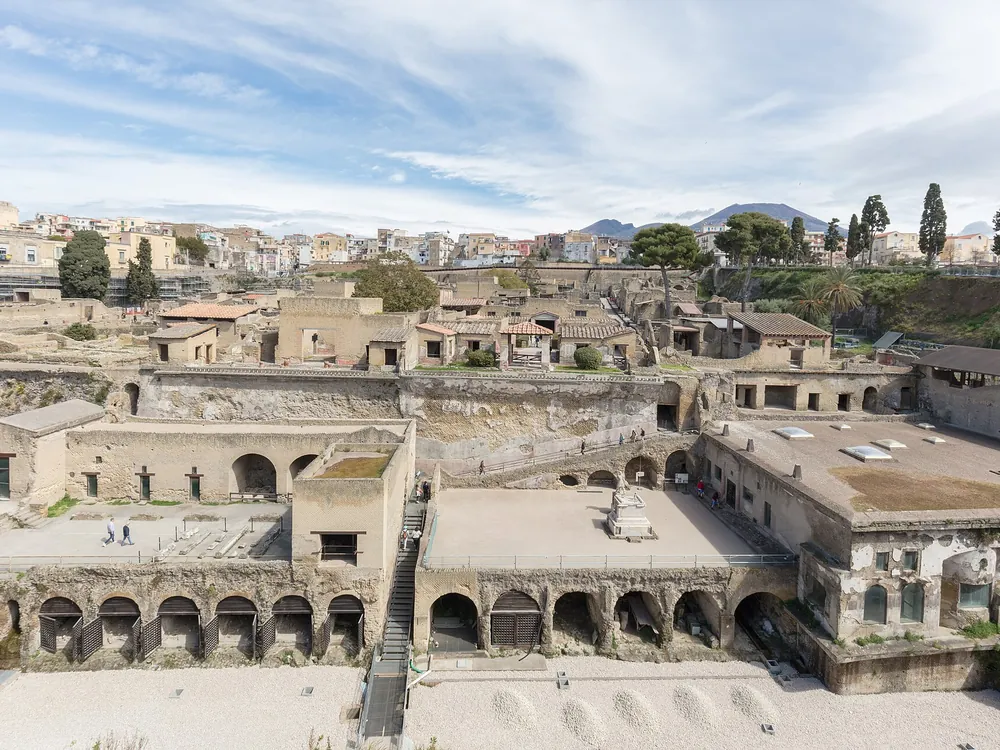
Herculaneum is about twenty minutes by train from Naples and works well as a half-day trip, even on your own: no coach, no tour required. It's smaller than Pompeii, but the mud from the eruption of 79 AD sealed the town in a layer that kept the air out, so wood, roofs and colours survived here that are long gone at Pompeii. Below you'll find the train to take, 2026 ticket prices, a two-hour walk through the houses and mosaics, and how to pair it with Pompeii or Vesuvius.
How to get to Herculaneum from Naples
The easiest way is the Circumvesuviana, the EAV Naples-Sorrento line: it leaves from Porta Nolana, stops at Garibaldi under the Central Station, and reaches Ercolano Scavi in about twenty minutes. From the station it's a ten-minute walk downhill to the park entrance on Corso Resina. Not every train on the Naples-Sorrento line stops at Ercolano Scavi, so check the departure board before boarding rather than just the direction.
The alternative is Trenitalia: regional trains on the Naples-Salerno line stop at Ercolano, in town, a bit further from the site than the Circumvesuviana station. If you're coming from or heading to Pompeii, it's simple: it's the same line, Ercolano Scavi is just a stop along the way, so you can do Pompeii first and get off here on the way back, or the other way round.
Tickets, hours and what's closed
The park opens every day at 8.30am. From 16 March to 14 October it closes at 7.30pm, last entry 6pm; from 15 October to 15 March it closes at 5pm, last entry 3.30pm. It's closed only on 25 December and 1 January, according to the official site ercolano.cultura.gov.it.
Full price is 16 euros, reduced to 2 euros for EU citizens aged 18 to 25, free under 18. Entry is also free on the first Sunday of the month and on a couple of other dates set each year by the Ministry of Culture. Buy online at coopculture.it or at the ticket office: online is worth it on weekends, when the queue gets long.
One thing to know before you go: the Villa dei Papiri and the Ancient Theatre are currently closed for maintenance, so don't count on seeing them. The rest of the site, the houses and the baths, stays open.
The visit: two hours among houses and mosaics
Herculaneum was a town of merchants and wealthy families, smaller than Pompeii but richer in detail: you walk a tight grid of a few streets, and two hours covers almost everything without rushing. Pick up the map at the entrance, since some houses open and close on rotation.
Casa del Bicentenario and Casa a Graticcio
The House of the Bicentenary, excavated in 1938 two hundred years after digging began, still has its upper floor standing and a checkerboard mosaic on the vestibule floor. Nearby, the Casa a Graticcio shows the town's cheapest building technique, a timber frame filled with stone and mortar: it's the reason the wood survived here and vanished elsewhere.
The baths and the mosaic of Neptune and Amphitrite
The Central Baths still have stucco on the ceiling of the cold room. But the piece everyone photographs is in the House of Neptune and Amphitrite: a wall mosaic, not a floor one, with the sea's colours almost intact after two thousand years under the mud. Nearby, the College of the Augustales keeps frescoes of Hercules that are still legible.
The ancient shoreline and the buried boats
Heading down to what's now called the Fornici area, you reach the toughest part of the visit: here, along the line of the ancient coast, the remains of hundreds of people were found who were waiting to escape by sea when the wave of mud overtook them. One of the fishing boats found there is still visible, overturned under a shelter. From this point, looking toward the sea, you can tell how far the coastline has retreated in two thousand years: today the site sits more than four hundred metres from the beach.
Herculaneum with Pompeii or Vesuvius
If you have the time, the trip stretches in two directions. The first is Pompeii, on the same Circumvesuviana line about twenty minutes further south: it's huge and worth half a day on its own, covered in this guide to Pompeii from Naples. If you want to see both towns at a relaxed pace, with an archaeologist explaining why the eruption treated them so differently, there's a ready-made tour in Pompeii and Herculaneum in one day with an archaeologist.
The second direction is Vesuvius, the volcano that caused all this: the trail to the crater starts from a car park reachable by bus from Herculaneum itself, and the climb takes under two hours round trip. Before setting off, it's worth reading our guide to hiking Vesuvius: crater tickets are booked online and the trail closes in strong wind. If instead you want to see where the most delicate finds from Herculaneum ended up, charred furniture and jewellery included, there's the National Archaeological Museum in Naples, covered with a guide in this MANN visit.
Frequently asked questions
How much time do you need to visit Herculaneum?
Two hours are enough for a full walk through the main houses, the baths and the mosaic of Neptune and Amphitrite. If you want to stop and read every panel and take your time with photos, allow up to three hours.
Is Herculaneum better than Pompeii?
They're two different sites, not one better than the other. Pompeii is huge and shows a whole town; Herculaneum is small but better preserved, with wood, roofs and colours that are gone at Pompeii. With only half a day, Herculaneum is the more relaxed visit.
Can you visit Herculaneum without a guide?
Yes, the site has information panels in every house and the map at the entrance marks the route. If you want to go deeper, the tour with an archaeologist is still worth it, especially for the story of the eruption and the ancient shoreline.
How do you get to Herculaneum without a car?
With the Circumvesuviana from Porta Nolana or Garibaldi, getting off at Ercolano Scavi: from there the park is a ten-minute walk downhill. It's the same train that goes on to Pompeii and Sorrento.
Herculaneum works well even as a morning visit, leaving the rest of the day free to head back to Naples or on to Vesuvius. Other visits among ruins, museums and churches are gathered in the Art section, and for more ideas for the day there's things to do in Naples. Anyone who wants to see where everything sits, from the ruins to the train stations, can open the map of Naples.
Information checked on 5 November 2026, on the official site of the Herculaneum Archaeological Park and on pompeionline.net.
For the rest of your stay: things to do in Naples today, this weekend and in the days ahead, checked every morning.
- herculaneum
- herculaneum from naples
- herculaneum ruins
- circumvesuviana
- pompeii and herculaneum
- day trips from naples

Who wrote this
Gianluca Scanni
Founder @ Cose Fighe