Pompeii in a day from Naples: the Circumvesuviana to Pompei Scavi, 2026 tickets and hours, a five-hour route round the ruins and adding Herculaneum.
Pompeii is half an hour from Naples by train and makes an easy day trip, no coach or tour needed, as long as you know three things: which station to leave from, which ticket to buy and which gate to go in by. Below you'll find the journey, the tickets, a four-to-five-hour route through the ruins and how to pair it with Herculaneum or Vesuvius.
How to get to Pompeii from Naples
The easiest way is the Circumvesuviana, the local commuter railway run by EAV, on its Naples-Sorrento line. It leaves from Porta Nolana, stops at Garibaldi (underneath Napoli Centrale, the main station) and in just over half an hour drops you at Pompei Scavi-Villa dei Misteri. The Porta Marina entrance is a stone's throw from the platform: step out, cross over and you're in the queue. Buy your ticket at the station or on the EAV app, or tap a contactless card at the gates that take Tap&Go. Remember to tap out too, or the fare won't be calculated properly.
Watch out for the wrong line. Trains to Poggiomarino also go through Pompeii, but they stop at Pompei Santuario, near the Piazza Anfiteatro entrance on the other side of the site. That works too, as long as you know. You'll spot the Sorrento trains on the departures board.
The alternative is Trenitalia, the national railway: regional trains on the Naples-Salerno line stop at Pompei station, in the modern town, and from there the Pompei Link service takes you to the ruins. On Sundays, in the periods when it runs, there's also a Rome-Pompeii Frecciarossa (high-speed train) that stops at Napoli Centrale at 10.13am and reaches Pompeii at 10.40am, returning from Pompeii at 6.40pm. Handy if you're coming from Rome for the day; before you count on it, check on the Trenitalia website that it's running that Sunday.
Tickets, opening hours and rules: what to know first
The site opens every day at 9am. Until 14 October it closes at 7pm, last entry 5.30pm; from 15 October to 15 March it closes at 5pm, last entry 3.30pm. It's only closed on 25 December and 1 January.
These are the tickets in force since 12 January 2026, according to the official website, pompeiisites.org:
- €20: the ancient city only, without the suburban villas.
- €25: the ancient city plus the Villa dei Misteri and Villa di Diomede, Villa Regina at Boscoreale with its Antiquarium, and the shuttle bus.
- €30: all of the above plus Oplontis, the Stabiae villas and the Stabiae museum, valid for three days.
- Reduced to €2 for EU citizens aged 18 to 25.
The detail that catches lots of people out: the Villa dei Misteri (Villa of the Mysteries) isn't included in the €20 ticket. If you want to see the red frescoes of the Dionysian rite, get the €25 one. Tickets are in your name, you'll be asked for ID at the entrance and they're valid for one entry only, so no popping out for lunch and coming back. There's a cap of 20,000 visitors a day: buy online on Vivaticket, the channel the Park recommends, especially at weekends. Rucksacks and bags can be no bigger than 30x30x15cm; anything larger goes in the left-luggage.
Entry is free on the first Sunday of the month, and the next one is 4 October. Free also means crowds: if you only have one day and can choose, a Tuesday or Wednesday with a ticket is better. The Park publishes how free Sundays work on its Orari e tariffe (hours and prices) page: check it a few days before.
Round the ruins: four or five hours without doubling back
Pompeii is a real city, not a museum: it's a couple of kilometres of Roman paving stones from one end to the other, and which houses are open changes through the year. Pick up the map at the entrance or download it from the website, because it shows what you can visit that day. This is a route that works, from Porta Marina to the Amphitheatre.
The Forum and the Basilica
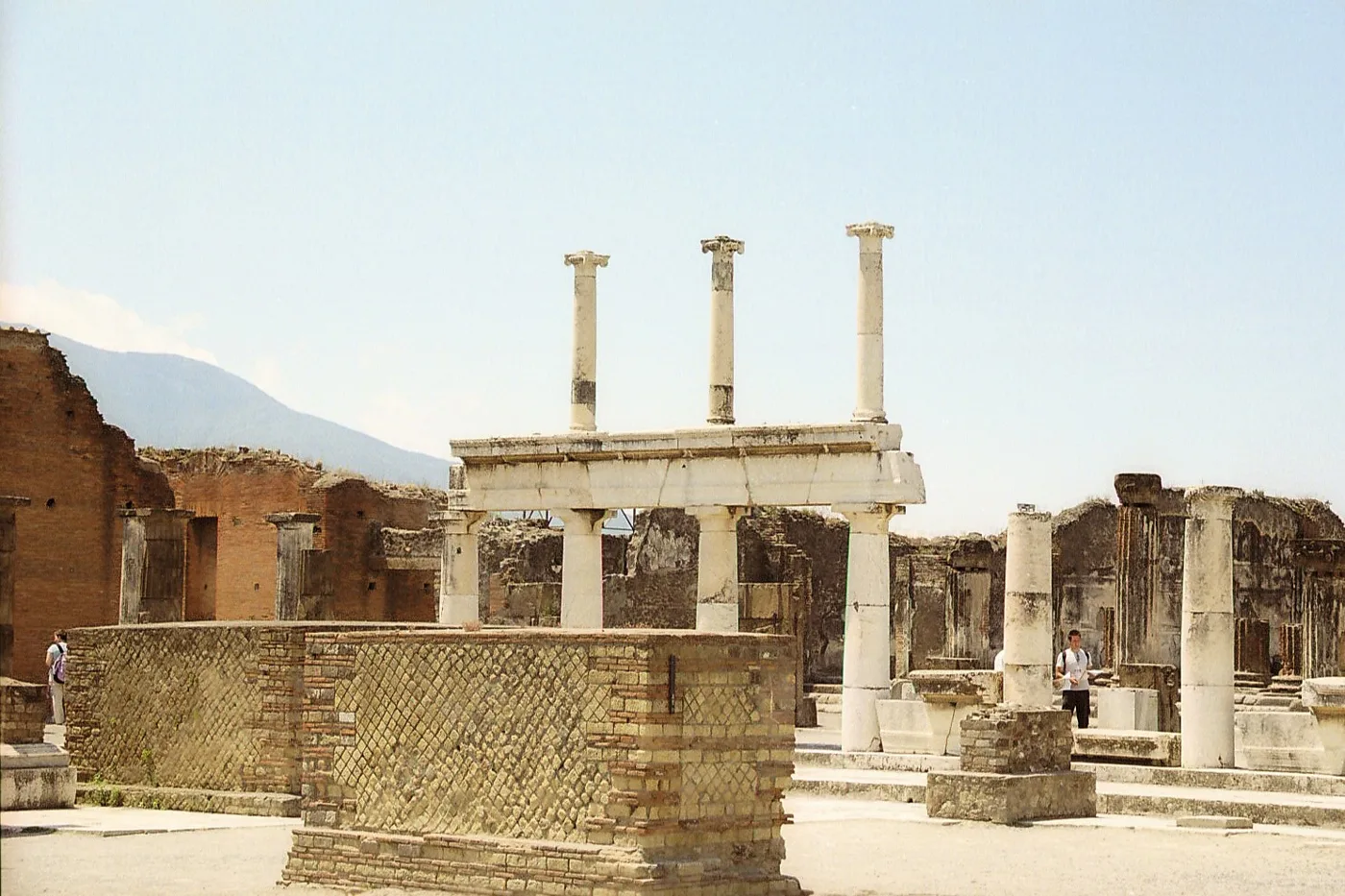
You enter at Porta Marina, walk uphill and five minutes later you're in the Forum, the long square with Vesuvius in the background. Around it are the Temple of Jupiter, the Basilica where justice was administered and the granaries holding the plaster casts of the victims. Allow half an hour.
Casa del Fauno and Villa dei Misteri
From the Forum head north to the Casa del Fauno (House of the Faun), the largest house in the city, with the bronze statuette of the dancing faun in the impluvium, the rainwater basin in the atrium. The Alexander mosaic that covered the floor is now at MANN, the archaeological museum in Naples, but the house makes perfect sense without it. Then leave through Porta Ercolano and walk along Via dei Sepolcri, the street of tombs, to the Villa dei Misteri, outside the walls: ten minutes on foot, and the room with the red-background frieze is worth the €25 ticket on its own.
The Stabian Baths and the two theatres
Head back towards the centre and take Via dell'Abbondanza, the main street. The Terme Stabiane (Stabian Baths) are the oldest in the city: changing rooms, hot and cold rooms, stucco ceilings. A little further down are the Teatro Grande, which held a few thousand people, and the Odeion, the small covered theatre for music. Five minutes sitting on the steps is the best way to rest your legs.
Via dell'Abbondanza to the Amphitheatre
From here walk east along Via dell'Abbondanza, past shops, thermopolia (Roman takeaway counters with jars sunk into the bar) and election slogans painted on the walls. At the end you'll find the Palestra Grande (Great Gymnasium) and the Amphitheatre, the oldest Roman stone amphitheatre still standing. Leave by Piazza Anfiteatro and you're close to Pompei Santuario station, with no need to cross the whole city again.
Pompeii with Herculaneum or Vesuvius
If you've energy to spare, the trip can stretch in two directions. The first is Herculaneum (Ercolano), on the same Circumvesuviana line at the Ercolano Scavi stop, halfway between Naples and Pompeii. It's smaller and takes two hours, but it's better preserved: the volcanic mud sealed in wood, upper floors and colours. Pompeii in the morning and Herculaneum in the afternoon is doable, but at a brisk pace and without the Villa dei Misteri. If you want to see both with someone explaining what you're looking at, there's Herculaneum with an archaeologist, ticket included, two hours in a small group.
The second is Vesuvius, the volcano behind all of this. Climbing to the crater and then going down to Pompeii tells the story in the right order. If you'd rather not think about buses and tickets, Vesuvius and Pompeii in a day leaves Piazza Garibaldi by coach, with entry tickets included and pizza halfway through the day. If you'd rather go on your own, read our guide to hiking Vesuvius first: crater tickets are booked online and the path closes in strong wind.
If you'd rather have a guide
You can do Pompeii on your own, but with someone who knows it you stop looking at walls and start reading a city: who lived where, what the shops sold, what the graffiti say. The easiest option is Pompeii with an archaeologist guide, ticket and coach from Naples: half a day, picked up in the city and brought back, with the afternoon free.
Other visits to ruins, museums and churches are in the Art section. And if you want to see where everything is, from Pompeii to the centre of Naples, open the map of Naples: the ruins, the stations and the other day trips are all on it.
- pompeii
- pompeii from naples
- circumvesuviana
- pompeii ruins
- day trips from naples

Who wrote this
Gianluca Scanni
Founder @ Cose Fighe