Rione Sanità: the catacombs of San Gennaro and San Gaudioso, the Fontanelle Cemetery, Jorit's murals, the Jago museum and the Vergini market.
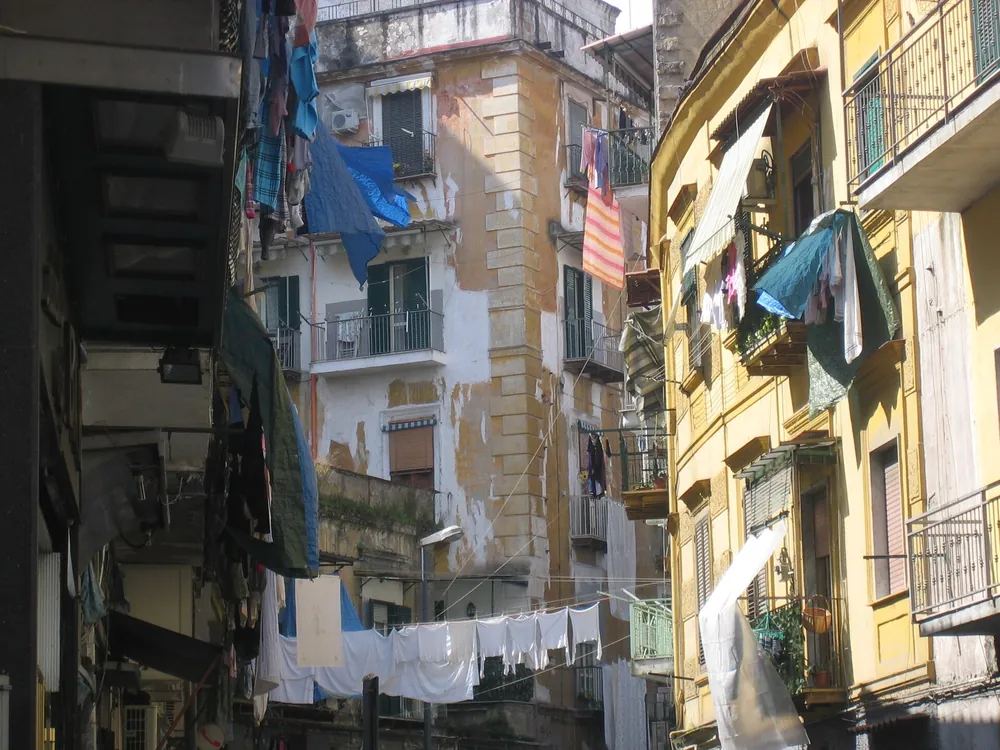
Rione Sanità is just behind Porta San Gennaro, a ten-minute walk from the Archaeological Museum. For decades the rest of the city looked at it from a distance, as somewhere to avoid. Then a group of young locals got the catacombs under their own houses back on their feet, opened a museum in a church that had been shut for forty years, and started sending visitors to eat at the market where residents do their shopping. These days you can see the whole neighbourhood in a morning, between underground galleries, baroque palazzi and murals, and the money from every ticket stays in the area.
The catacombs of San Gennaro and San Gaudioso
The Catacombs of San Gennaro are at via Capodimonte 13, next to the Basilica del Buon Consiglio, and they're the oldest Christian site in the city: galleries cut into the tuff with frescoes over a thousand years old, and the Crypt of the Bishops. Open every day except Wednesday, 10am-5pm; the tour is guided, in Italian or English, lasts about 45 minutes, and groups leave every hour, so booking ahead is standard practice. A full ticket costs 13 euros and stays valid for twelve months, which also covers the nearby Catacombs of San Gaudioso, Naples' second early-Christian cemetery, under the Basilica di Santa Maria della Sanità: back in the 1600s, noble families were buried here with their skulls set into the walls in plain view. That visit lasts 45 minutes and is run, like San Gennaro, by La Paranza, the local youth cooperative that brought both sites back to light.
The Fontanelle Cemetery and the anime pezzentelle
The Fontanelle Cemetery is an ossuary carved into the hillside's tuff quarry, reopened on 18 April 2026 after a long restoration. This is where the cult of the anime pezzentelle was born, the souls of the poor: Neapolitans would adopt a nameless skull, give it a place among thousands of others, and pray to it in exchange for a favour. Open six days a week, closed Wednesdays and 25 December, 10am-6pm with last entry at 5.15pm; on Mondays and Fridays it opens earlier, at 9am, for anyone who just wants to pray. Entry is free, with booking required, for residents of Naples' first and second municipalities; everyone else pays from 6 euros for a self-guided visit up to 8 euros for the guided one. Booking online is compulsory either way, since each time slot only takes a handful of people. The full story, with the three aisles and the history of the cult, is covered on the guided tour of the Fontanelle Cemetery.
Murals, Palazzo dello Spagnuolo and the Vergini market
The neighbourhood is also an open-air museum. At the start of via San Gennaro dei Poveri, near the entrance to the catacombs, there's the saint's face painted by Jorit, with the two red stripes across the cheeks the artist uses in all his portraits. Another mural, by Jerico Cabrera Carandang, covers a pillar of the Ponte della Sanità, now renamed Ponte Maddalena Cerasuolo after the partisan courier who stood in the way during the Four Days of Naples to stop the Germans blowing it up with dynamite. From there you head down to Borgo dei Vergini, where the market of the same name keeps its usual pace, between fishmongers, fruit stalls and fry shops.
On via Vergini, Palazzo dello Spagnuolo and Palazzo Sanfelice have the double-ramp staircases that have become one of the most photographed sights in the city: the entrance halls are open in daylight hours and there's nothing to pay. To do all this with someone who knows the facades and the stories behind each shop, there's the tasting walk between the murals and Palazzo dello Spagnuolo, which starts and ends at Porta San Gennaro with pizza, mozzarella, taralli and babà, a rum-soaked sponge cake, along the way.
The Jago museum at Sant'Aspreno ai Crociferi
Sant'Aspreno ai Crociferi is a 17th-century church at the start of Borgo dei Vergini, shut for forty years and reopened in 2021 as sculptor Jago's studio; since 2023 it's been a museum of his work, the Pietà above all. Open Monday to Thursday, 10am-1pm, last entry 12.30pm, and Friday to Sunday, 10am-5pm, last entry 4.30pm. A full ticket costs 8 euros, bought online only, not at the door, and it also covers the Figlio Velato (Veiled Son) in the nearby Basilica di San Severo alla Sanità. The tour of the Jago museum is guided by young people from the neighbourhood, lasts 25 minutes, and is wheelchair accessible.
Seeing it all in three hours, or one piece at a time
If you've only got a morning, the Miglio Sacro, the Sacred Mile, links San Gennaro's tomb in the catacombs to the neighbourhood above it in three hours: seven stops with entry fees already included, from the catacombs to the Basilica di San Gennaro extra moenia, from Santa Maria della Sanità to the streets of the rione, all the way to Palazzo Sanfelice and Palazzo dello Spagnuolo. It sets off at 9.30am on Saturdays, Sundays and public holidays, and finishes at piazza Cavour, next to the Archaeological Museum. If you'd rather go it alone, remember that the catacombs, the Fontanelle and the Jago museum all need booking online in advance: there's simply no such thing as a ticket at the door here.
You can get there on foot from piazza Cavour, on metro line 1, or by bus from Port'Alba: it only takes ten minutes to step into a neighbourhood that feels like another city. Before heading back to the centre, stop at the Vergini market for a cuoppo, a paper cone of fried snacks, or a coffee, and if you're still up for walking, Things to do has the rest of the city to see on foot.
- rione sanità
- catacombs of san gennaro
- fontanelle cemetery
- murals in naples
- jago museum
- naples neighbourhoods

Who wrote this
Gianluca Scanni
Founder @ Cose Fighe